Blog

  • Winners and Losers: The Appeals Court and the Métis as “Indians”

    Winners and Losers: The Appeals Court and the Métis as “Indians”

    half maskOttawa has a history of appealing Aboriginal victories in the courts.

    So far, its fight over recognition of jurisdictional responsibility to Métis people has run up a multi-million dollar tab, and everyone watching the last Federal Appeals Court ruling expects lawyers will be dining out very nicely on the file again and again.

    In April 2014, the Appeals Court ruled Ottawa must regard the Métis in the same light as “Indians” under the Constitution. It seems so obvious. It’s there in black and white in Section 35 (2) of the Charter of Rights and Freedoms which flatly states: Métis people, like Indians and Inuit, are Aboriginal. Meaning, when you read the word “aboriginal” in the Constitution, it covers Indians, Inuit and, yes, Métis people.

    Justice Eleanor Dawson of the Appeals court used the definition of “Métis” people outlined in the Powley decision:

    …the term refers to a distinctive group of people who developed separate and distinct identities. The three broad factors that are the indicia of Métis identity for the purpose of claiming Métis rights under section 35 were found to be: self-identification, ancestral connection and community acceptance.

    But here’s the tricky part. That, in and of itself, does not guarantee Métis the same rights that many believe Indians enjoy under the Constitution. What’s more, ten million people of mixed Indian and European heritage will not automatically be regarded as Métis. (Which makes me wonder: if you are Indian-and-Asian or Indian-and-African, why are you NOT regarded as Métis? And why is it that such a great number of Indian Status holders who don’t actually have two native parents find themselves legally regarded as First Nations and not Métis?)

    The fear among non-natives is that everyone in Canada is going to be on the hook for millions in costs for the education, healthcare and housing of Métis people. Those same non-natives also fear they’ll have to move because they’re living on land previously ceded by treaty to the original Aboriginal title-holders.  That’s not what the ruling means. In its simplest form, what the ruling means is that if there’s a dispute about hunting and fishing rights, or a demand for daycare services, Ottawa can’t palm it off on a province or territory or municipality. Put in simpler terms still: Ottawa’s being told to suck it up and play by its own rules.

    scrip

    All along, the Métis argument has been that, constitutionally, Ottawa has had a fiduciary relationship with Métis people because it has all along regarded the Métis as Aboriginal. It did so decades ago when it wooed some Métis with the “Scrip” scam — promising land entitlement if they would only vacate any claims against the government. It did so over half a century ago when it created a ‘no alcohol’ law and applied it to Indians “and others like them.” It literally spelled it out in the 1982 British North America Act. In short, Ottawa wrote the very rules it has argued do not really apply here.

    Some historical Métis communities — including that of Rainy River in Ontario, St. Paul des Métis in Alberta, and the Red River Métis of Manitoba — have had documented agreements with Canada. For land and services.  With spotty delivery records to be sure, but agreements, unfulfilled or not. They are proof. So Ottawa is being told to take its medicine.

    But the same Appeals court ruling found — strangely, I think — that those deemed “non-Status Indians” aren’t necessarily “Indians” constitutionally. These are people who lost Status when they married out of the community. Or who walked away from their communities to avoid racism from outside by “passing” as something else. Or the children of relationships in which one partner is not recognized as a band member. Or people who move away for a job, relationship, safety or housing and don’t go home again. Keep in mind, some bands have very stiff regulations about membership dealing with blood percentages or family trees or unbroken residency. Feuds on the rez can leave you on the outside of all decision making and those rules never get changed.

    The upshot, as far as I can interpret it, is the Appeals court was signaling that Ottawa has a constitutional obligation to a “group” but not the individuals who make up the group. And if that is the case, it may be time to start looking around to see if you live in a “community” of Métis people — or if you are a Métis resident of  a varied community. Because the things that make you Métis — having the genetic makeup, self-identifying that way and speaking michif — aren’t enough when the battle moves to a fight for education or housing. Ottawa has an obligation to communities of people. And in the legal system, that usually calls for historically defined communities.

    Which means all those people who drifted or ran away to make a better life, or to gain the right to vote, or get a chunk of land to call their own or for any other coercive reason, are only likely to gain moral satisfaction from this ruling.

    Not a bad start I’d say.

  • Gone to Hell: Toronto’s Don Jail Extension Comes Tumbling Down

    Gone to Hell: Toronto’s Don Jail Extension Comes Tumbling Down

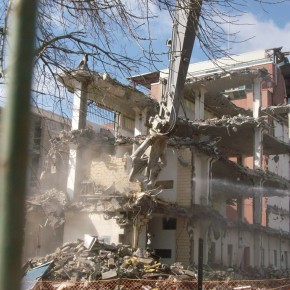
    march don 2014 028The Don Jail in Toronto has housed thousands of suspects and convicts in its over one hundred year history. Given what we know of our penal system, more than a few of those detainees have been Aboriginal men and women.

    Not that I’m sentimental about it. The inmates, by and large, were not nice people. Some were killers and sex offenders. Others were petty thieves with a violent streak. And some were too addled to know how they ended up there. Many were themselves victims before slipping across the line to the other side of the cell.

    As with many correctional facilities in Canada and elsewhere, ‘The Don’ was known for its overcrowding, degradation and despair. By 1977, it was supposed to be a place for short term stays. But 90-day waits for a hearing could, and did, stretch into 330 days for some, including one native man, Gabriel Dorian.

    That’s almost an entire year crammed into a roach-infested cell meant for two, bunks already taken, and no room to walk beside them. No time outside the cell. No ten minutes outside to stretch your legs. I know, for tough justice types, that may sound minor. I know too of that impulse to wish hardship on the kind of people who randomly punch old women in the face and rob them.

    But then I try to imagine how well I’d cope if every time I sat down on a bus or park bench someone else came along and sat on top of me and stayed there. Knowing, quite possibly, that they recently arrived after stabbing someone else to death.

    The subhuman conditions of the Don — combined with the personal histories that brought some detainees there (Gabriel Dorian among them) — were often reason enough for a judge to refer inmates to other facilities.

    But for many, it was the last stop. Some were executed at the Don. Some died there without a judge’s say so.

    march don 2014 036 Not so long ago, I looked on as the Don was bashed into oblivion, heard the screeching of iron bars being ripped from their sockets, felt the plaster grit in my hair.

    Toronto has a new detention centre for inmates who would have once been shipped to the Don. I don’t know if it will make a difference. But, to me, it’s nothing but good to have the old one gone.

  • Bodies and Contested Lands

    Bodies and Contested Lands

    In this fifth instalment of the #UMNATV Colloquim series here on MEDIA INDIGENA, Masters student Leslie Agger offers this take on Nina Wilson’s March 12 speech to a small audience of mostly University of Manitoba graduate students.

    IMG_2808
    Nina Wilson (left) addresses a group of mostly #UMNATV students

    Nina Wilson is a self-described Indigenous activist and mother best known as one of four founding members of the Idle No More (INM) movement. Though INM was originally concerned with the federal government’s Omnibus C-45 bill, the discourse has become expanded to include such fundamentals as Indigenous identity, youth empowerment, and land because, as she explains, corporate exploitation of resources degrades the social cohesiveness of Indigenous people and their communities.

    For a variety of reasons, Wilson has focused her efforts on land and Aboriginal rights. The lands about which she is concerned are contested spaces. They are the traditional homelands of Indigenous people but they are also the locations of proposed industrial projects. In this discourse, First Nations and industry typically each claim the right to determine if, how, and what activities occur on them. Wilson, along with her supporters, provides assistance to local Indigenous groups attempting to prevent (or perhaps play a greater role in) resource exploitation. As it were, she provides the additional “bodies” required to occupy contested lands currently slated for development. Wilson is aware that she may put herself and her family at risk to do so.

    Wilson’s talk specifically dealt with the criminalization of women in resistance movements. She informs us that women, especially mothers, are at the forefront of efforts to protect Indigenous lands. Often, however, this activity renders them vulnerable to violence, state removal of children, and prosecution with few measures to ensure their protection and well-being other than their own anonymity. According to Wilson, Indigenous people have already “done everything” to change things institutionally.

    IMG_2809
    Another photo of Wilson at #UMNATV Colloquim

    In addition to providing information about efforts to advocate for positive societal change through protest and legislative amendments, Wilson discussed two arguably contentious measures. First, she suggested partnering with groups based on shared interests, but apparently without consideration of ethics. She stated: “There are many people who share our enemies. We will build an alliance with those people regardless of whatever else they do.” Her comment left me pondering the age-old question about the degree to which the end truly justifies the means.

    Second, while highlighting the need to link with people and groups who have not been criminalized, Wilson also discussed the possibility of identifying individuals willing to be jailed for a cause. Although this is a personal decision that requires great personal sacrifice, it begs the question of whether this type of conflict is the only means for propelling change. Are negotiations truly a futile exercise?

  • Restoring our Sacred Identities

    Our ongoing series of #UMNATV Colloquim reflections continues today with MA student Andrea St. Pierre, as she shares her thoughts about a recent presentation by Leslie Spillett.

    IMG_2383
    Lesley Spillett at #UMNATV Colloquim

    Based on Leslie Spillett’s spirited discussion with us, the work she is involved in with Indigenous people in Winnipeg, and her daughter’s sincere and adoring introduction, I could tell that Leslie is very passionate about the work she is involved with at Ka Ni Kanichihk and about continuing her culture’s traditions. Leslie raised her children to be active members of their culture and traditions. I believe that learning about your background in a safe and nurturing environment is important in developing a strong identity. For some Indigenous people, being able to positively identify with who they are and where they from is very difficult, especially for those affected by multi-generational traumas (such as residential school). Luckily for Leslie’s children, they have a strong woman who is grounded in her traditions to teach them.

    I was especially interested in Leslie’s perspective regarding the pervasive ideology that Indigenous people ought to view themselves as lesser than Euro-Canadians. Our existence (education system, family system, etc.) was undeniably questioned and attacked in various forms to eliminate or assimilate us. Multiple attempts of genocide in many different institutions were employed to rid our society of the “Indian problem.” For generations, Indigenous people were taught that their opinions and way of life were savage. Sadly, this is still evident in the media coverage, negative comments, and racism in our society.

    Indigenous people must restore their identities to combat these harmful and vicious views of Indigenous people. We must be able to view ourselves as equally valid as our Euro-Canadian counterparts. It begins with us, with our people in our communities. If we do not believe that we are equal, we will never be equal. I once believed that I was not as smart or would not be as successful at my endeavors because I was an Indigenous girl. I sabotaged myself because I believed that I deserved less. When I became aware of the issues and reasons why I had this negative attitude, I was able to confidently learn about my culture and traditions, and push myself to succeed in various aspects in my life.

    I agree that it is important to restore the sacred, to free us from colonialist attitudes. Similar to the Restoring the Sacred and At Our Relatives’ Place (AORP) programs at Ka Ni Kanichihk, my own research involves decolonizing attitudes based on traditional knowledges, traditions, and teachings. My research is specifically directed towards decolonizing sex and sexuality to benefit Indigenous youth. I believe that this is important because it benefits every living generation of Indigenous people, by educating us about our beliefs before contact with Europeans and how they have been altered since. Restoring traditional teachings regarding sex and sexuality would free Indigenous people from the colonized mindset.

    IMG_2371
    #UMNATV students and guests with Spillet

    I appreciated Leslie’s discussion with us and would like to thank her for giving us her time and thoughts. It was great to hear an Indigenous academic perspective into what is happening with Indigenous people. Although she claims that she is non-academic, I believe that Leslie is highly academic, not the Western concept of academia but the Indigenous concept, carrying with her an abundance of her people’s traditional and cultural knowledges. Unfortunately, this is a quality that many people sorely lack. I hope that society will be able to accept that Indigenous knowledge is a different and valid form of education that is not bound by the same limits as Western education.

  • Reconstruction and Reconciliation in the Manitoba Act of 1870

    The third in MEDIA INDIGENA’s series of graduate student writings from the #UMNATV Colloquium series, the following piece by U of M Native Studies PhD Student Jason Bone was submitted after a presentation by University of Saskatchewan Native Studies professor Adam Gaudry

    1902718_520994401350135_1859109935_n
    U of S professor Adam Gaudry (left)

    In his well-attended talk entitled “The Manitoba Treaty of 1870: Reconstructing Metis-Canada Confederation Building,” professor Adam Gaudry questioned Canada’s claim in 1869 to have purchased the Northwest Territories from the Hudson Bay Company (HBC), a question he based on the way HBC acquired title to the land in the first place. Citing the Doctrine of Discovery — a key point missed by many, according to Gaudry — the professor identified how the company has not ever truly received legal ownership but rather participated in a long process of opportunistic exploitation of First Nations through trade and politics.

    For instance, during the Treaty Four negotiations at Fort Qu’appelle, O-ta-ka-o-nan (or “The Gambler”), raised important questions to Treaty Commissioner Alexander Morris on how HBC received title to the land. He asked specifically why they received payment for land they did not own, leading Gaudry to conclude that it was well understood that much of Manitoba was stolen territory and the legal claims of the HBC were very much in doubt among the area’s Indigenous residents.

    Canada has a weak legal position in claiming the Prairie provinces, stated Gaudry, and many scholars question the legal foundation of the Natural Resource Transfer Acts of 1930, which supposedly justified this claim. The problem lies in the earlier Manitoba Act of 1870, which Gaudry argued is a treaty that recognizes over 50 years of Metis land title and gives the community a legal argument and precedent within Canadian law. Using scholars such as James Tully and J.R. Miller and a keen chronological analysis found in the voices of Metis like Louis Riel’s journals, Gaudry aptly explained that the Métis are both a legal and political entity with established governance systems like the Buffalo Hunt Council, along with the capacity to negotiate treaties just as First Nations had.

    A basic model to Gaudry’s argument cites these central events on a timeline:

    • Early 1869: Canada purchases territorial and governance rights from HBC
    • July/August 1869: Metis organize patrols and roadblocks. Buffalo Hunt Government
    • November 1869: Metis prevent Canadian Governor from entering. Effectively preventing transfer
    • December 1, 1869: Metis declare Provisional Government and intention to negotiate
    • February 1870: Metis and Canada agree to negotiate for entry into confederation
    • May 1870: Canada passes Manitoba Act. First phase of ratification
    • June 1870: Provisional Government ratifies the Manitoba Treaty. Second phase of ratification
    • August/September 1870: Arrival of British infantry and Canadian Militia. Systematic attacks and eventual suppression of Metis Self-governance

    Most interesting was Gaudry’s question to the audience, “What if Thomas Scott was never killed?” After some equally interesting responses, Gaudry suggested that this act resulted in a reductive treatment of the Manitoba Treaty of 1870 and a long period of “mob justice” enacted by the British infantry and Canadian militia, The Wolseley Expedition. This prevented a true Metis vision of Canada – and Manitoba – from ever being realized, starting cycles of relationships that continue to have an impact today. Gaudry suggests the only solution is to revisit this original vision, recognize Metis land claims and begin a project of redress, to start a process of reconciliation that can re-start relationships based on mutual respect and dialogue. The Manitoba treaty provides a template to do so.

    1003071_516830595099849_1501114126_n
    Students at Gaudry #UMNATV presentation

    I completely agree with Gaudry’s presentation of the original vision and timeline of critical Metis events prior to Manitoba becoming a province in 1870. It is a realistic, historical view of how Manitoba was settled. The key to this original vision is the spirit and intent for both the Metis and the government. The Metis at this time still had the presence of power and force to resist aggression by any nation. Therefore, the starting point of this relationship was based on equality and partnership. Each needed the other to legitimize the process.

    However, I am not totally convinced of Gaudry’s claim that Metis had a treaty with the Crown prior to the treaty making process starting in 1871. This claim appears to say that Metis rights supersede First Nation treaty rights. Take note of the Selkirk treaty of 1816 between First Nations and the Crown. I think Gaudry is piggybacking on the legal perspective of settling outstanding First Nation land claims, as Canadian law is now recognizing Aboriginal title.

    In his research, Gaudry relied on Robert Alexander Innes’ book, Elder Brother and the Law of the People. The problem is that Innes relies on existing written literature about the history of First Nations people prior to 30 years ago. By relying on that existing written history of First Nations — which ranges from distorted to completely untrue due to the authors exclusively Western perspective — the foundation of Innes’ book is therefore weakened. When writers do this, they have a fear of alienating themselves from the existing thought of historical writings. To have a balanced way of looking at reconciliation today, I would prefer to include oral history as evidence to be reflective of the First Nations perspective, and recent Supreme Court decisions are now entertaining the concept of Indigenous law (including oral history).